Epoxy Resin Explained: The Big Beginner's Guide | Dein-Epoxidharz
Do you want to work with epoxy resin for the first time and are wondering which resin you need, how epoxy resin works, and which mistakes you should avoid?
Then you've come to the right place. Epoxy resin simply explained: What is epoxy resin, how does it work, and which resin is the right one for your project? The big beginner's guide with tips, instructions, and professional knowledge.

Epoxy resin is a versatile plastic consisting of two components: resin (component A) and hardener (component B).
Only by mixing both components does a chemical reaction begin. The liquid material hardens and transforms into a solid, transparent, and extremely durable plastic.
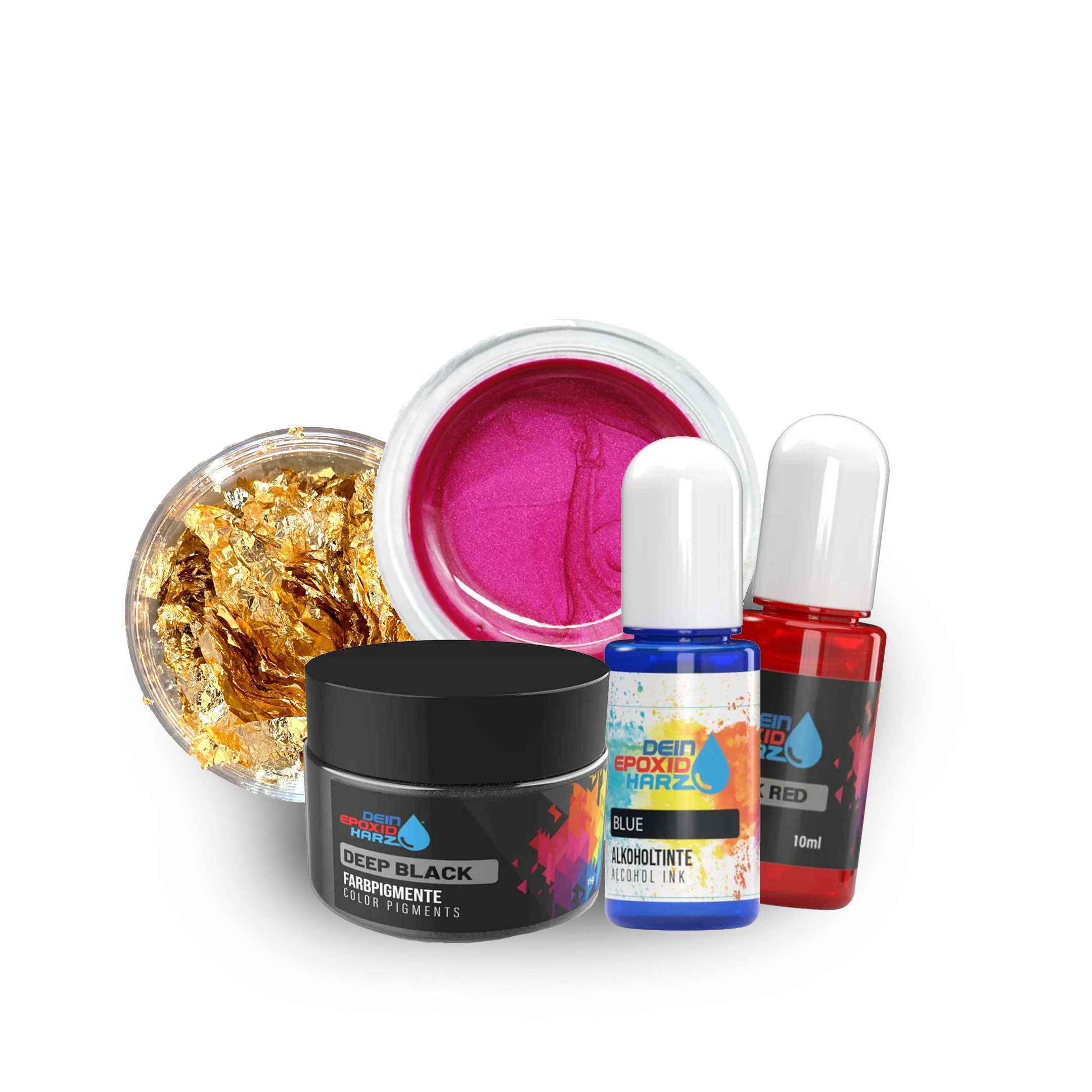
After full curing, epoxy resin possesses many impressive properties: crystal-clear transparency, high strength, waterproof, chemical-resistant, good adhesion to many materials, versatile in terms of colorability.
Therefore, epoxy resin is now used in numerous areas – from arts and crafts to industry.

The application possibilities are almost unlimited.
Popular applications include:
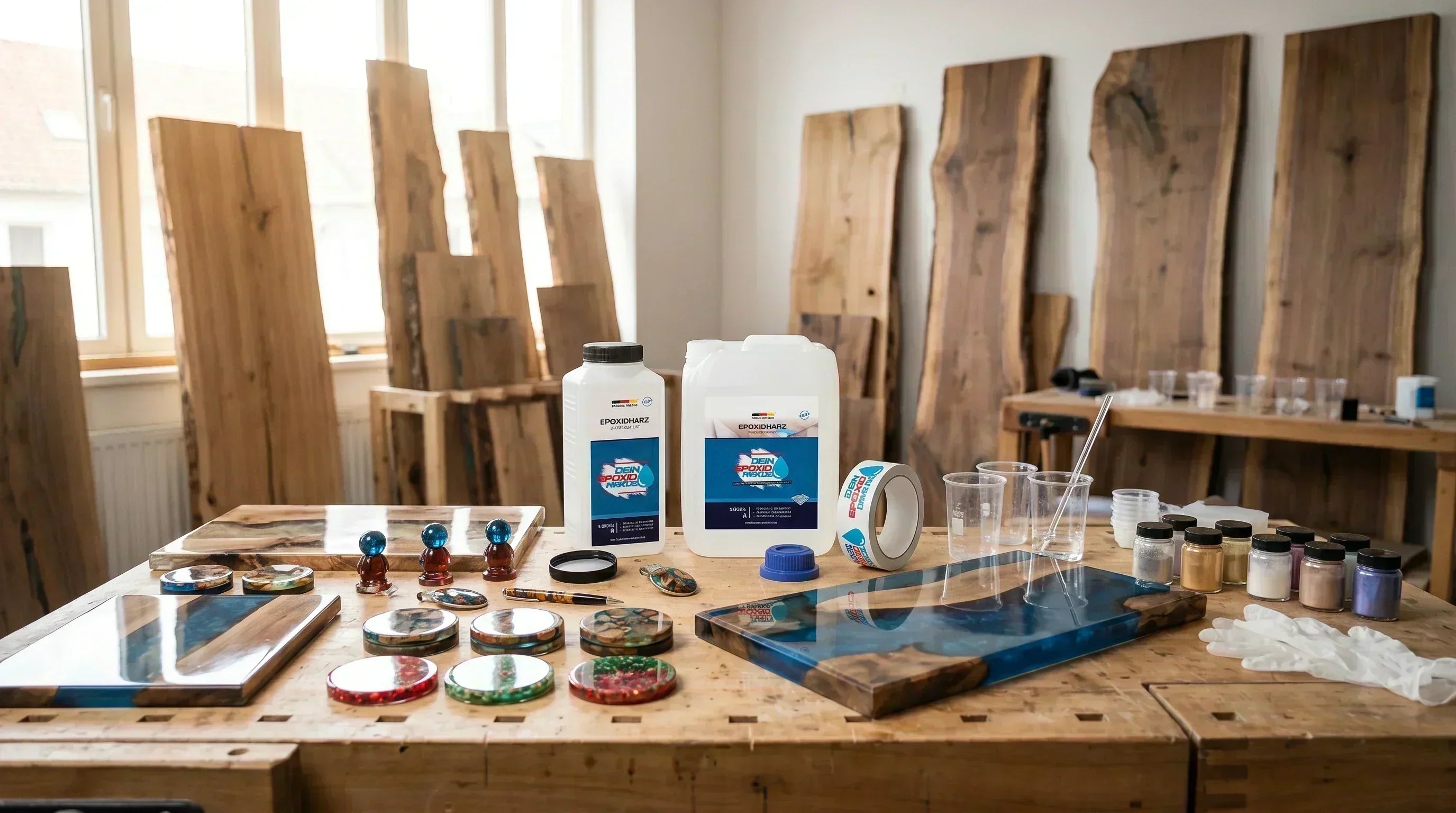
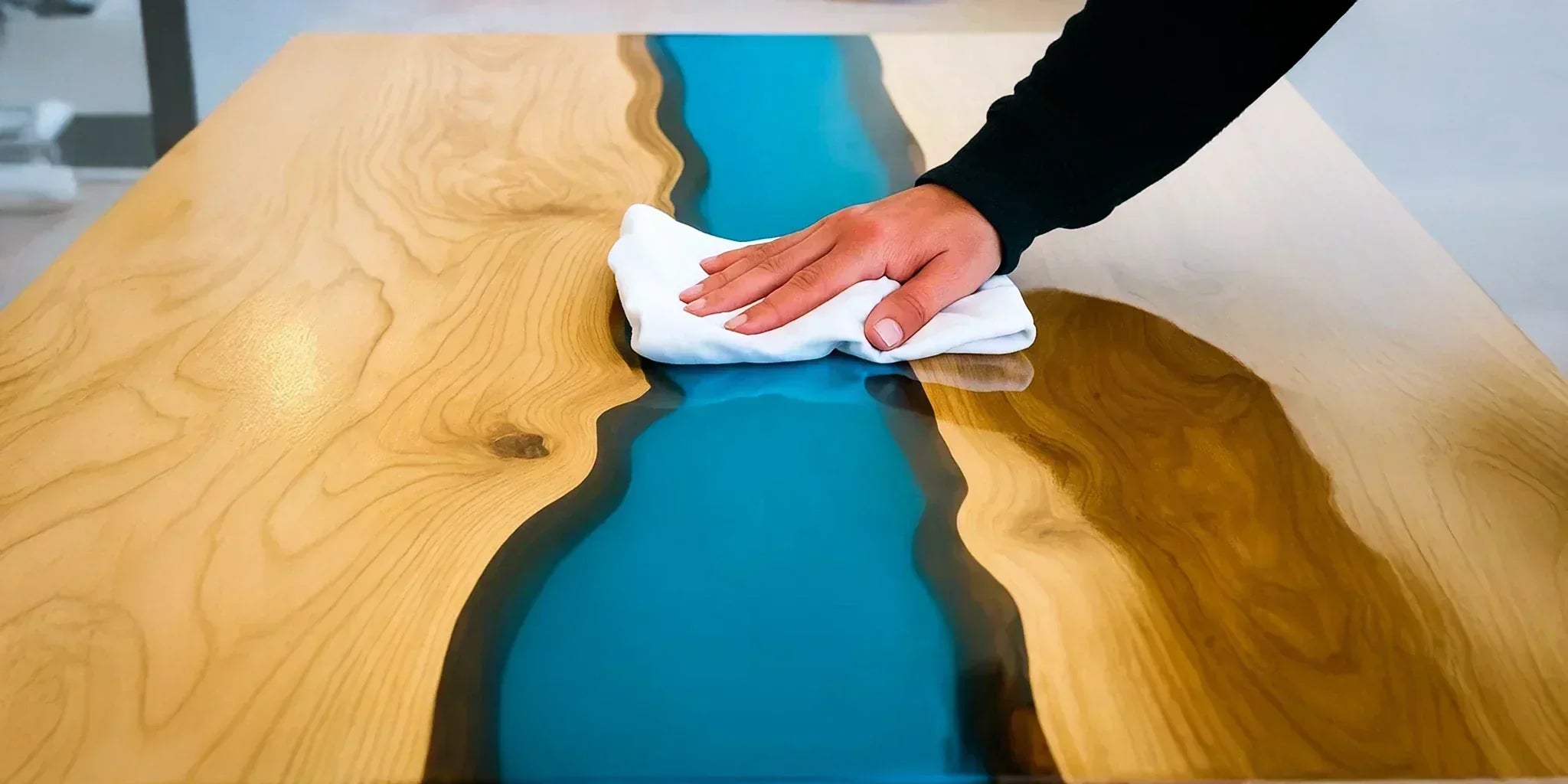
Especially popular today are Rivertables, where wood and epoxy resin are combined to create unique pieces of furniture.

Once resin and hardener are mixed, a chemical reaction begins. The following happens: resin and hardener combine. The material slowly thickens. Heat is generated. The resin hardens. After several hours or days, a solid plastic is formed.
This heat generation is called an exothermic reaction.
Caution: The larger the quantity poured, the more heat is generated. Therefore, epoxy resin should not be poured to an arbitrary thickness.

This is by far the most common question. The right choice depends on what you want to create.
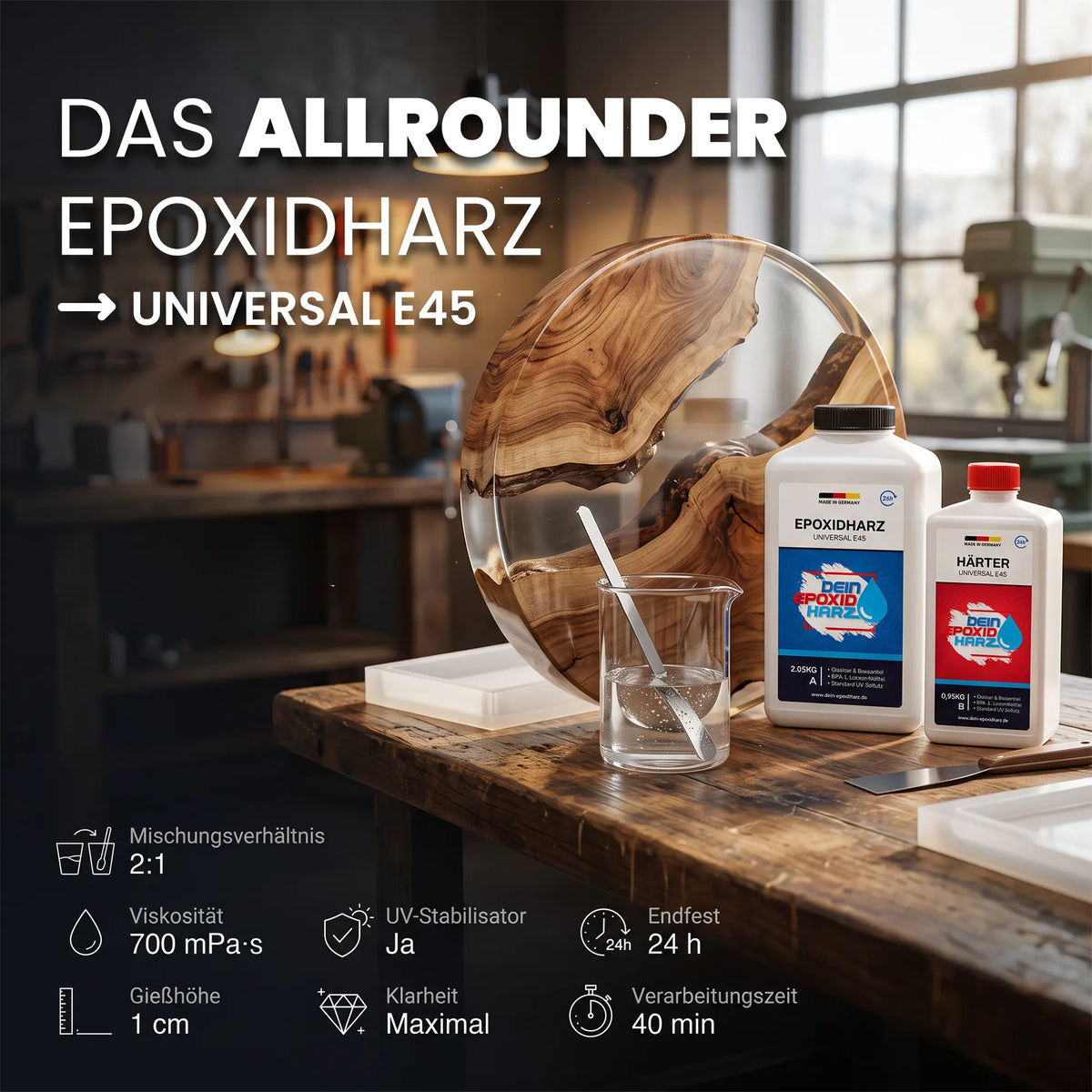
Universal Epoxy Resin E45 Ideal for pouring up to 1cm thick: Coatings, seals, floor coatings, laminating, wood sealing, smaller castings.
Advantages: versatile, easy to process (mixing ratio 2:1), good value for money.
Thick-Layer Resin D600 Ideal for pouring up to 10cm thick: River tables, large castings, deep molds, wood epoxy resin projects.
Advantages: high layer thicknesses possible, very good transparency, low heat development, perfect for massive casting projects.
Resin Art Series Ideal for pouring 1-3cm thick: Artworks, geodes, paintings, coasters, jewelry.
Advantages: crystal clear, self-degassing, particularly beautiful surface, mixing ratio 1:1.

up to 1cm
2:1
up to 1cm
2:1
up to 1cm
2:1
up to 1cm
2:1
up to 1cm
2:1
up to 1cm
2:1

For your epoxy resin project to go smoothly, it is important to calculate the required quantity in advance. Otherwise, you risk running out of material in the middle of the process – and in the worst case, you'll have to start over.
Rule of thumb: Length (cm) x Width (cm) x Height (cm) x Density (1.16) / 1000 = Required quantity in kilograms.
Don't feel like calculating? Our Epoxy Resin Quantity Calculator takes care of that worry for you! Simply enter the dimensions, and you'll get the exact amount of resin and hardener for your project. This way, you ensure you are optimally prepared and achieve perfect results.
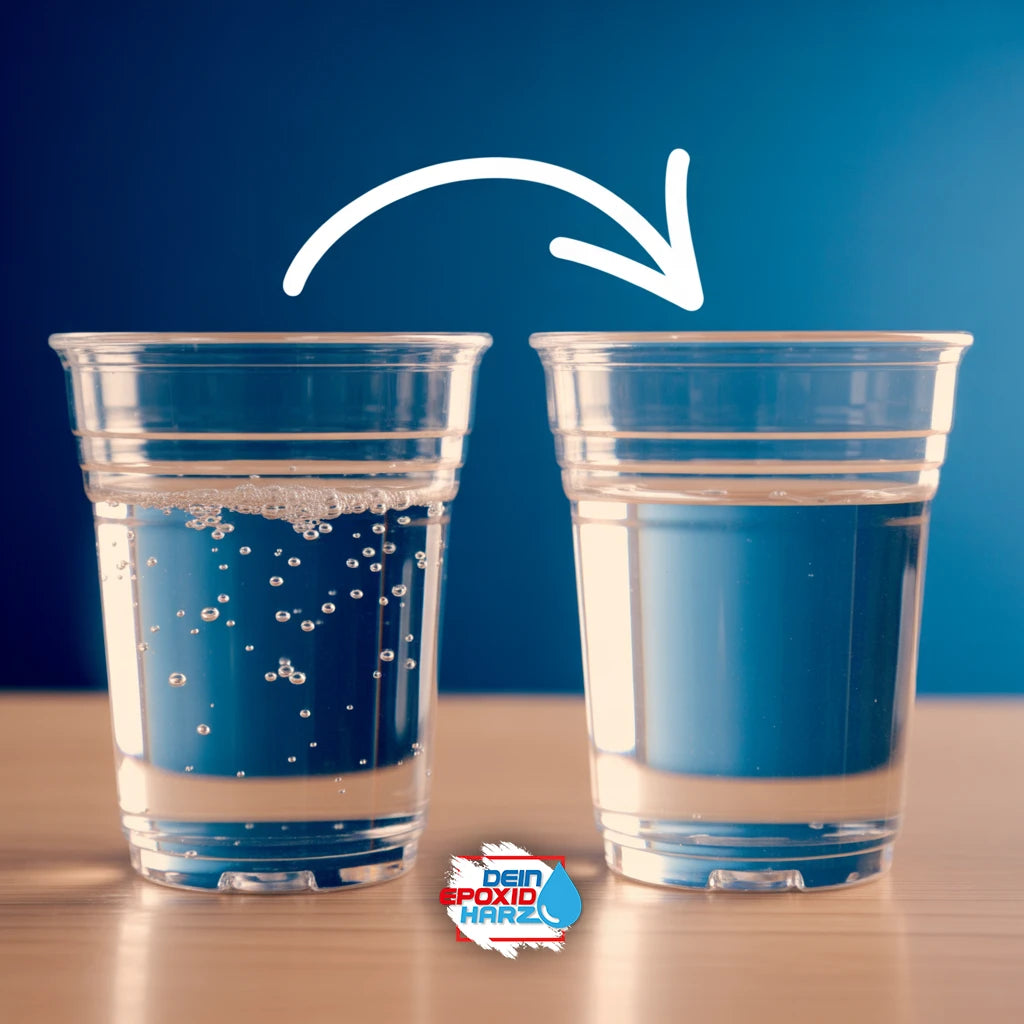
Bubbles are among the most common beginner problems. Possible causes usually include: stirring too quickly, damp wood, air in cracks and pores, material that is too cold, incorrect pouring technique
Tips: stir slowly, seal wood beforehand, bring resin to room temperature, use a de-aeration roller or heat gun.
You can find a detailed article on how to avoid air bubbles in epoxy resin here.

Sticky epoxy resin usually results from an incorrect mixing ratio, insufficient mixing of resin and hardener, or too low processing temperatures. High humidity can also impair curing and lead to a streaky, sticky surface. If only the surface is affected, a so-called amine blush can often be the cause.
Pay attention to the correct mixing ratio, thorough stirring, and a room temperature of at least 20 °C. This ensures complete and uniform curing.

The maximum layer thickness depends on the specific resin system. A universal resin can often only be poured a few millimeters thick (up to 10mm). A deep pour resin, on the other hand, can allow for several centimeters in one pour.
Important: The larger the total volume, the greater the heat development. For very large projects, always work in multiple layers.

Short and clear answer: Yes. Every epoxy resin yellows over time due to UV radiation.
However, our systems contain UV stabilizers and anti-yellowing agents, which significantly reduce or delay this effect.
For outdoor applications, a UV-resistant 2K PU clear coat is also recommended as a protective layer.

Anyone working with epoxy resin for the first time should start with a manageable project.
Coasters, small decorations, or a simple wood seal are perfect for gaining initial experience.
With the right resin, a little patience, and thorough preparation, impressive results can be achieved even with the first project.
Whether it's a river table, art project, coating, or mold making – you'll find the right epoxy resin for every application with us. Our specially formulated resin systems ensure optimal results for every project.

Please fill out the following form to declare your withdrawal from the contract.