
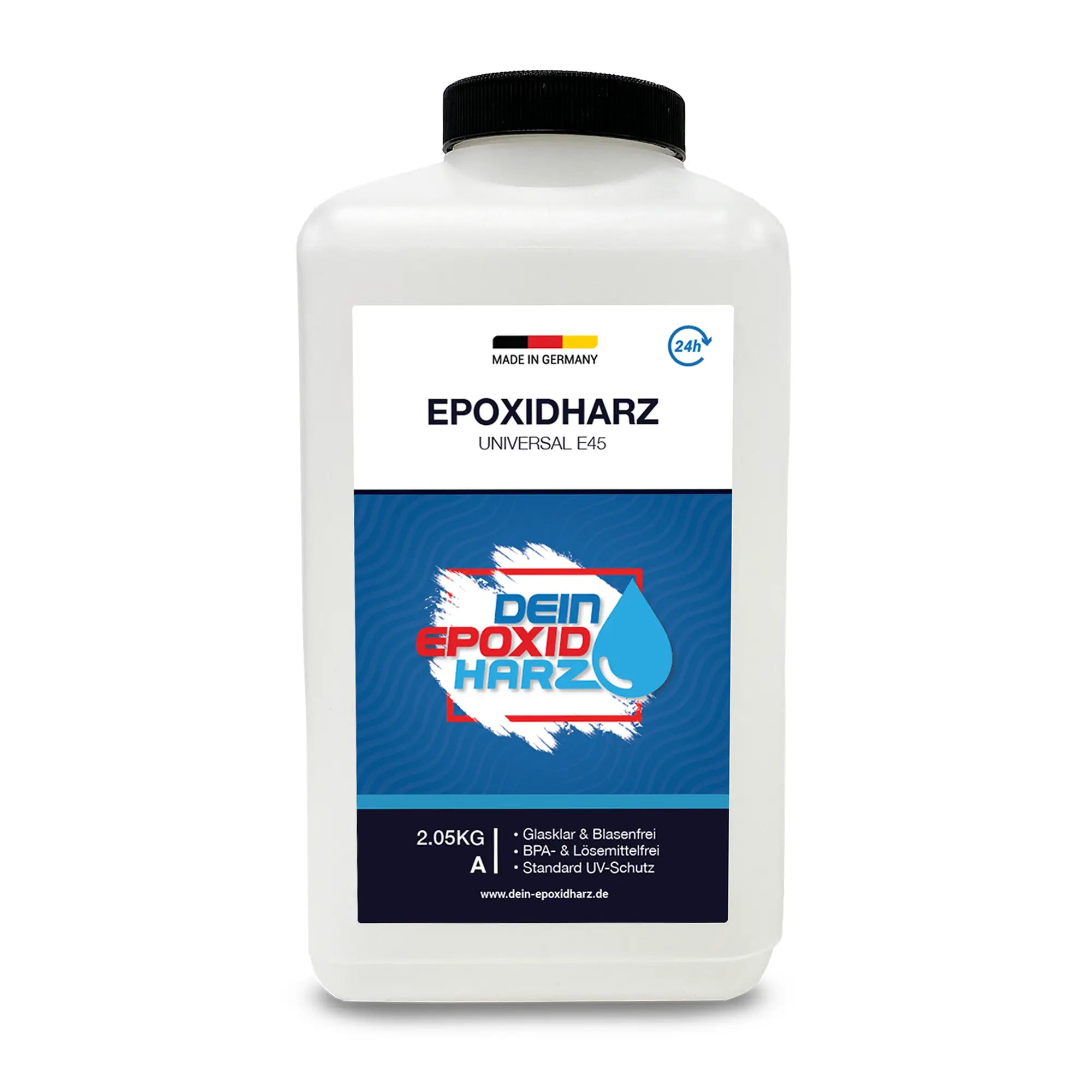
E45 Universal Epoxy Resin 2.0L (no set)
2.0 kg single component A
- Top quality : BPA- and solvent-free high-quality liquid casting resin for crystal-clear, transparent and bubble-free casting results.
- Versatile applications : woodworking, model making, boat building, mold making, laminating, floor sealing, pond construction, terrariums and much more.
-
Made in Germany : The epoxy resin is manufactured and bottled exclusively in Germany.
-
Also known as : epoxy resin, epoxy - epoxy - epoxyt - epoxid, synthetic resin, laminating resin, crystal resin, casting resin, resin
• Auf Lager - in 1-3 Werktagen bei dir.
Pairs well with
E45 Universal Epoxy Resin 2.0L (no set)
Please do not hesitate to contact us with any questions about our products, delivery and payment terms, or for individual quotes. We look forward to hearing from you!
-
Product Availability
All products in our shop are immediately available! Depending on the delivery address, shipping then takes 1-2 days within Germany, and correspondingly longer for international deliveries.
-
Ask us
Should you have any questions about a product or the implementation of your project, our experts are at your disposal.
-
Frequently Asked Questions
Many questions about epoxy resin and its processing are answered in our FAQ section.
Processing time
maximum pouring height
Ideal room temperature
until fully cured
Mixing ratio
UV protection
Viscosity
Product details
Product description
Universal Epoxy Resin E45 – Versatile, Simple, Reliable
Our Universal Epoxy Resin E45 is the perfect solution for numerous applications: from coating and sealing wood surfaces, furniture, and tabletops to processing interior design objects. It is ideal for potting electrical casings, insulating electrical terminals, and lamination work in the automotive sector.
The resin also impresses with its quality and ease of use in model making, repair work, or for robust floor seals. Whether it's a hobby project or professional craftsmanship – with our E45 universal resin, you always achieve first-class results.
Winter Tip:
For optimal results, we recommend mixing the resin at room temperature (approx. 20–22 °C). Cold conditions (below 5 °C) can delay or prevent the curing process – ideally, ensure that the resin and hardener are sufficiently tempered before processing.
Hazard statements
E45 Resin Component
Danger
H315 Causes skin irritation.
H319 Causes serious eye irritation.
H317 May cause an allergic skin reaction.
H411 Toxic to aquatic life with long lasting effects.
Precautionary statements
P261 Avoid breathing dust/fume/gas/mist/vapours/spray.
P273 Avoid release to the environment.
P280 Wear protective gloves / eye protection / face protection.
P305+P351+P338 IF IN EYES: Rinse cautiously with water for several minutes. Remove contact lenses, if present and easy to do. Continue rinsing.
P333+P313 If skin irritation or rash occurs: Get medical advice/attention.
P501 Dispose of contents / container in accordance with local / regional / national / international regulations.
EUH205 Contains epoxy constituents. May produce an allergic reaction.
Instructions & Safety Data Sheets
Find the instructions for our Universal Epoxy Resin E45 here: Instructions
For the SDS, please send us an email to: sds@dein-epoxidharz.de
Included in the set
Harz
Harder

Gloves
Instructions
Hazard pictograms





UNIVERSAL EPOXY RESIN E45
Disclaimer
Epoxy resin is a versatile plastic used for various applications such as coatings, adhesives, and moldings. It consists of a mixture of epoxy resin and hardener, which undergo a chemical reaction during curing.
The final result when using epoxy resin can be influenced by many factors. These include, among others, the precise mixing ratios of epoxy resin and hardener, the ambient temperature and humidity during the curing process, the type and condition of the substrate on which the resin is applied, as well as careful and professional application and storage.
Due to these numerous variable factors, no guarantee can be given for the final result when using epoxy resin. The quality and durability of the resin depend significantly on the parameters mentioned and correct processing. Therefore, it is important to carefully follow the manufacturer's instructions and, if necessary, conduct preliminary tests to check the suitability of the epoxy resin for the specific application.
Frequently Asked Questions
Is epoxy resin toxic or harmful to health?
All our resins are manufactured in compliance with the European Commission's chemical regulations, and all components are Reach-compliant. Nevertheless, it should be noted that epoxy resin systems are hazardous materials. Uncured epoxy resin can cause skin irritation and allergic reactions, so protective measures such as gloves and respiratory protection are highly recommended. Direct skin contact should be avoided, as repeated exposure can lead to sensitization. When mixing and processing, adequate ventilation should be ensured to minimize the inhalation of vapors. After complete curing, epoxy resin is harmless to health.
Is the resin food-safe?
Due to its two-component chemical composition, epoxy resin is generally never 100% food-safe. A "food-safe" certificate is only ever issued for finished cast products. Likewise, our resin is not declared food-safe in its liquid state. Many of our customers use the resin for tables, jewelry, and containers.Once cured, contact with skin or food is not a concern.
Heat Resistance of Epoxy Resin
Epoxy resin is known for its excellent properties, but it is not completely heat or fire resistant. It can withstand high temperatures, but it is important to keep it away from very hot objects, such as hot pans or pots.
It is also worth knowing that with continuous heat of approx. 55°C, the epoxy resin changes its state from solid to rubbery. Nevertheless, it is suitable for use as a kitchen worktop, as long as very hot objects do not come into direct contact with the resin. It should also not be used as a coaster for tea or coffee cups unless it is protected against heat with a special protective lacquer.
In summary, epoxy resin is a good choice for use in areas with high temperatures, as long as it is kept away from very hot objects and, if necessary, protected against heat.
What happens if I don't follow the mixing ratio exactly?
The ratio of resin to hardener is crucial for successful curing. A deviation of more than +/- 5% can affect the molecular composition and thus also impair the result.
Too much epoxy resin can lead to a sticky surface, while too much hardener has a crystalline effect on the surface. To achieve an optimal result, it is therefore important to adhere strictly to the specified mixing ratio.
The resin is slightly milky on the surface, what can I do?
Possible causes for your problem: The material was not stirred 100 percent evenly and thoroughly, or the mixing ratio was not precisely met.
Suggested solution: 1st option Please brush the milky areas with colorless brandy vinegar (slightly diluted with water), wait about 30 minutes, and then rinse with clear water. (Good solvents also include acetone and isopropanol)
2nd option Sand the milky areas with 240-grit sandpaper until the milky surface is gone. Then, thinly coat the entire surface again with new resin using a roller or brush, and polish it to a high shine after curing, if necessary.
